








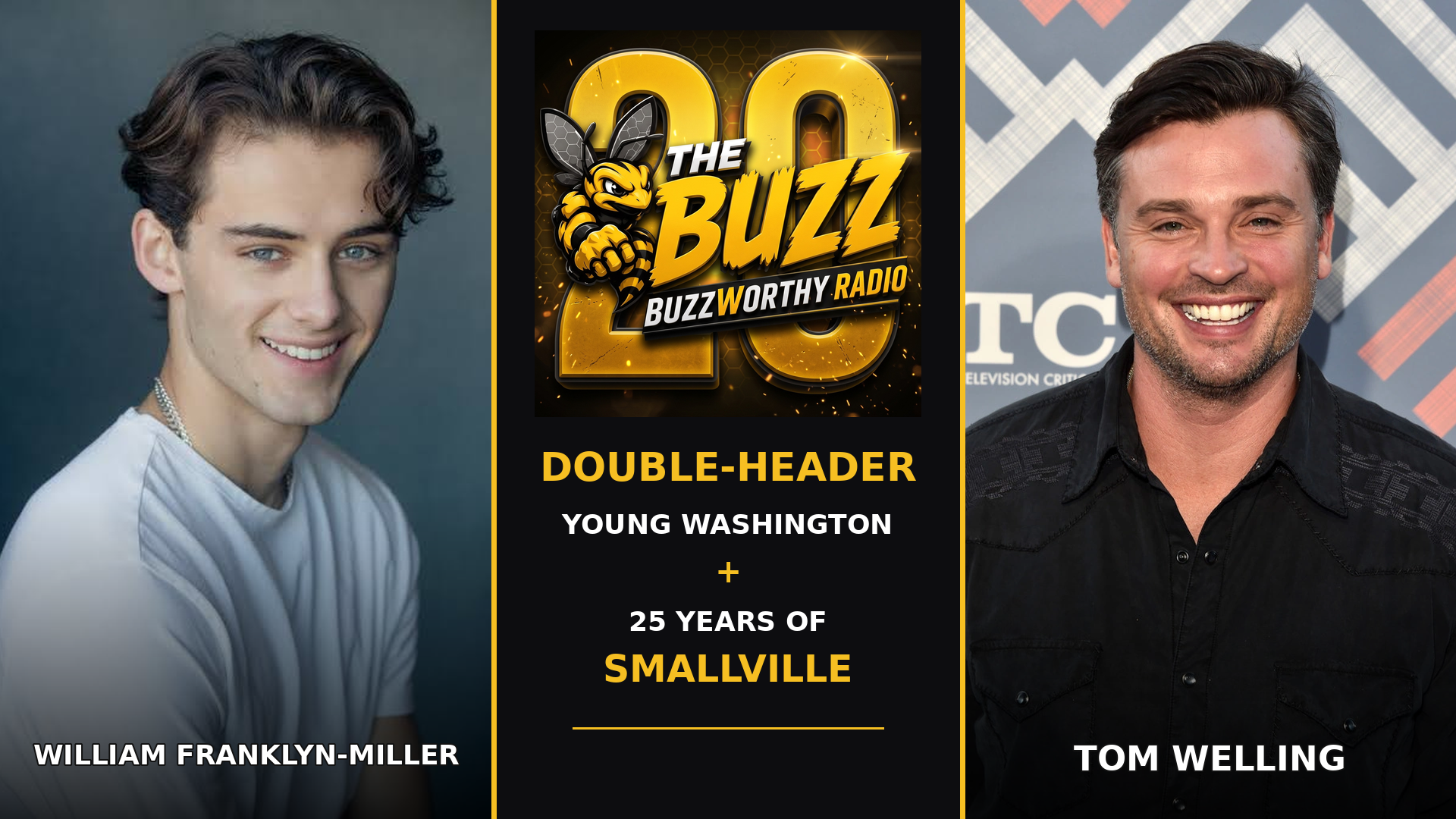
On this double-header episode of The Buzz, William Franklyn-Miller discusses portraying a young George Washington in Young Washington, while Tom Welling looks back at 25 years of Smallville, his journey to becoming Clark Kent, and the friendships that continue long after the series ended.
William Franklyn-Miller Brings a Young George Washington to Life
William Franklyn-Miller takes on the role of George Washington in Young Washington, a film that explores the formative years of the man who would eventually become the first president of the United States. While Washington’s later accomplishments are widely recognized, Franklyn-Miller admitted that he knew relatively little about the events of his younger years before reading the script.
The actor described the opportunity to portray Washington as a dream, particularly because the film examines a more vulnerable and human side of the historical figure. From dealing with grief and societal expectations to navigating uncertainty about his future, the story presented Washington as a young man facing challenges that audiences could recognize in their own lives.
One of the film’s pivotal moments became a particular point of discussion during our conversation. Without revealing too much of the story, Franklyn-Miller recalled filming a scene on a mountain where unexpected weather conditions transformed the atmosphere. Although the production initially anticipated clear views of the surrounding landscape, heavy clouds created a backdrop that ultimately enhanced the scene’s emotional impact.
Franklyn-Miller also revealed how quickly the production came together following his casting. He had approximately one week before traveling to Ireland, where he would undergo horseback riding, stunt, and military training. Adding to the pressure was his discovery that tickets were already being advertised before filming had even begun.
Working alongside Kelsey Grammer, Sir Ben Kingsley, and Andy Serkis provided another opportunity for the young actor to develop his craft. Franklyn-Miller explained how he observed their performances, paying attention to their choices with dialogue, character development, and the way they approached individual scenes.
Serkis also offered him advice about maintaining a lasting career in entertainment. When Franklyn-Miller asked about longevity, Serkis encouraged him to remain authentic and make every character unique, emphasizing the importance of consistently delivering strong performances.
Looking ahead, Franklyn-Miller discussed his involvement in Neuromancer, Netflix’s The Age of Innocence, and the independent film Conversion.
Tom Welling Reflects on 25 Years of Smallville
Twenty-five years after Smallville first introduced audiences to a teenage Clark Kent, Tom Welling continues to celebrate the series and its enduring connection with fans.
Our conversation began with some unfinished business from Fan Expo Philadelphia, where I previously met Michael Rosenbaum and Kristin Kreuk but missed the opportunity to meet Welling. Rosenbaum had jokingly given me a hard time about missing him, something Welling was more than happy to address when we finally connected for this interview.
The discussion also brought up a forgotten audition from earlier in Welling’s career. Before landing Smallville, he had auditioned for the role of Tag Jones on Friends, a part that ultimately went to Eddie Cahill. Welling recalled how the audition took an unexpected turn when another performer skipped dialogue that his character was supposed to repeat. His decision to respond by repeating the words “blah blah blah” left him convinced that he would not be getting the role.
Interestingly, Welling initially passed on the opportunity to audition for Smallville twice.
During pilot season, his representatives were hesitant about the project because the script was not being released. That changed when pilot director David Nutter offered him the opportunity to read it after signing a nondisclosure agreement. Once Welling discovered that the story centered on a teenager struggling to understand his identity, he recognized something different about the project. His first audition would ultimately be a final screen test opposite Kristin Kreuk, who had already been cast.
Despite landing the lead role, Welling acknowledged that he had considerably less acting experience than many of his colleagues. He credited Rosenbaum and John Schneider with helping him navigate the demands of the series, particularly during its early years. Their willingness to mentor him created an environment where the actors could support one another rather than compete for attention during scenes.
Welling also reflected on his experience working with Amy Brenneman on Judging Amy. Her encouragement and straightforward approach to acting helped him feel comfortable as a relatively inexperienced performer. He later carried that experience into Smallville, making an effort to welcome guest actors and ensure they understood how important their contributions were to the production.
That collaborative approach extended to his relationships with directors. Welling discussed the importance of communication, particularly during the demanding filming schedule, and how he would ask incoming directors about their preferred working methods. At one point, he even began asking directors to name their five favorite films as a way of establishing common ground.
Our conversation took a few unexpected turns, including a discussion about a signed Rocky collectible displayed behind him. Welling shared how Dolph Lundgren helped him obtain Sylvester Stallone’s autograph years earlier, and how he eventually met Stallone himself. Having recently attended the Tulsa King premiere, where I interviewed Stallone’s daughter Scarlet Rose Stallone, we had a little fun discussing my continued attempts to meet Sly.
Welling also talked about the Smallville conventions and cruises that bring cast members together with fans. The cruises offer a different kind of experience, with excursions, performances, and opportunities for attendees to interact with the actors. That discussion led to a few stories about my own past cruise experiences, including one particularly memorable night involving blackjack winnings and tequila shots.
Beyond the conventions and celebrations, Welling spoke about what the series continues to mean to its audience. Some fans have shared memories of watching Smallville with parents who have since passed away, while others are now introducing the show to their own children. He also recalled hearing from military personnel who watched the series while serving overseas, describing it as an opportunity to decompress during difficult circumstances.
Those experiences have given Welling a greater appreciation for the show’s impact beyond its original television run.
As Smallville celebrates its 25th anniversary, the relationships formed during its production remain an important part of its legacy. Welling discussed how his friendship with Rosenbaum has grown even stronger since the series ended, while the continued enthusiasm of fans has helped keep the show relevant for new generations.
Watch or listen to this double-header episode of The Buzz, featuring William Franklyn-Miller and Tom Welling, on Spotify and other podcast platforms.