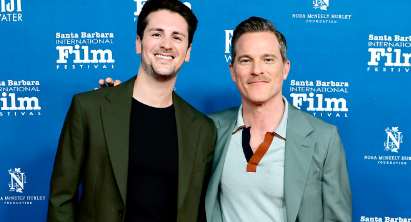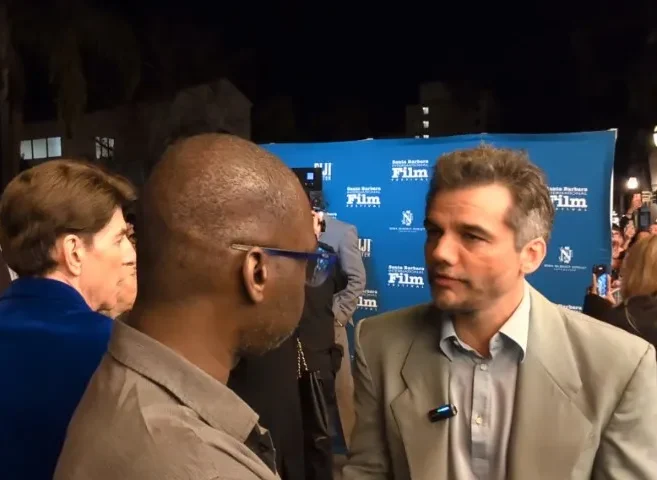











As I was about to embark to the 41st edition of the Santa Barbara International Film Festival (SBIFF), I had the opportunity to sit down with filmmaker Nicola Rinciari, whose feature debut A Mosquito in the Ear opens this year’s festival.
And let me tell you — this one stays with you.
A Story Rooted in Truth
A Mosquito in the Ear is inspired by a real-life adoption story and adapted from a graphic novel. The film follows American couple Daniela and Andrew (played by Nazanin Boniadi and Jake Lacy) as they travel to India to adopt a young girl, Sarvari.
What unfolds is not a simple “new family” narrative.
It’s a layered, emotionally complex exploration of:
- Cultural differences
- Language barriers
- Marital strain
- And the deeply human process of becoming a parent
From the moment Sarvari enters their lives, the emotional temperature shifts.
Rinciari shared that what drew him to the story was its dual perspective:
“There were two levels. It was both from the parents’ level — how do you become a parent in real time? — and then the intercultural meeting between this American couple and Sarvari and her customs.”
The Emotional Weight of Transition
One of the most powerful elements of the film is that Sarvari does not immediately embrace her new life. Why would she?
The orphanage is the only home she’s ever known.
There’s a pivotal moment where a group of boys tell her that an orphanage is “a place where people who don’t have families stay.” That scene broke me. It reframes everything. Adoption here isn’t a fairy tale — it’s grief, displacement, and fear.
And then there’s that moment — when Sarvari bites into a glass in a moment of overwhelming frustration. It’s shocking, visceral, and real.
Rinciari revealed that it actually happened in the real story. That’s when the audience fully understands: this is not a “bratty child” acting out. This is a child desperate to go home, unable to communicate her pain.
The film smartly withholds subtitles for most of Sarvari’s dialogue, placing us in the shoes of the parents — confused, grasping for understanding. But during that breaking point, subtitles appear.
Because her pain needed to be heard.
A Marriage Under Pressure
What struck me most was how the film subtly examines the couple’s relationship.
Andrew’s playful, slightly disorganized personality feels charming early on. But once parenthood enters the equation? Those same traits become a source of tension.
Daniela begins to see the same qualities differently.
Rinciari explained:
“The arrival of this kid really destabilizes the relationship. And so it’s how do you then come back from that?”
The film captures something incredibly honest — becoming parents doesn’t just add a child to your life. It changes the dynamic between partners.
And it doesn’t always look pretty.
A Cross-Cultural Production
Interestingly, the film’s production mirrored its story.
Rinciari and his team partnered heavily with Indian creatives — from production designers to costume designers — creating a true international collaboration.
He shared that roughly three-quarters of the crew were Indian, and the filmmaking process required navigating cultural differences behind the camera as well.
Art imitating life.
A Major SBIFF Moment
For Rinciari, this marks his feature film debut — and to have it open SBIFF is monumental.
Screening at the historic Arlington Theatre in front of thousands? That’s next-level.
“It’s a dream come true,” he told me. “You never know until the film is made and people respond to it.”
As someone who watched this film from the comfort of home before heading to Santa Barbara in person for the first time, I can say this:
A Mosquito in the Ear is not just a film about adoption.
It’s about understanding.
It’s about patience.
It’s about realizing that love doesn’t always arrive neatly packaged.
And it’s about recognizing that across cultures — we are far more alike than we are different.
Final Thoughts
There are so many moments in this film that linger — from the symbolic tiger plush that becomes a bridge between worlds, to the subtle glances that say more than dialogue ever could.
If you get the chance to see this, please do so.
Come into it with an open heart.
You’ll leave changed.
Watch the full interview with Nicola Rinciari above.